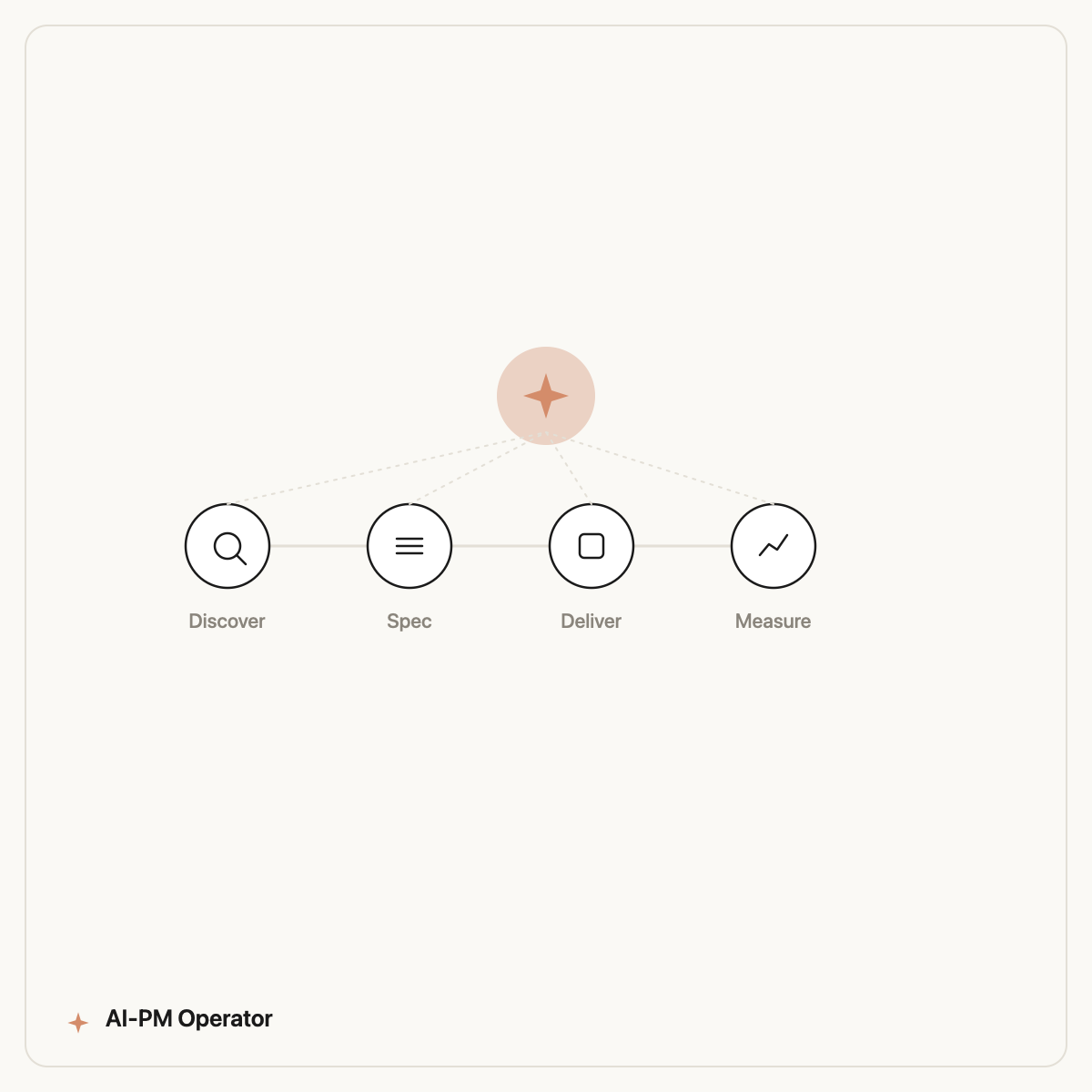
AI for product managers is no longer about asking a chatbot for ideas. In 2026 the highest-leverage use is operational: AI now reads your real data, drafts your specs, audits your board, and writes your reports — turning hours of weekly busywork into minutes of review. The PMs pulling ahead aren't the ones with the best prompts; they're the ones who wired AI into their actual workflow.
This guide is the practical playbook: where AI genuinely helps across the product lifecycle, where it doesn't, the critical difference between AI that advises and AI that executes, and a concrete way to start this week.
Watch: an AI agent connects to live analytics, diagnoses why activation dropped, and writes the report — execution AI in action.
What "AI for product managers" actually means in 2026
The phrase covers three very different things, and conflating them is why so many PMs feel underwhelmed. It helps to think in three layers:
- Chat assistants (ChatGPT, Claude.ai): you describe a task, it returns text. Great for thinking and drafting, but you are the integration — you paste data in and paste results out.
- Embedded copilots (AI inside Jira, Notion, Figma, your analytics tool): helpful in-context suggestions, but locked inside one product and limited to what that vendor exposes.
- Execution agents (Claude Code and similar): connect to your tools directly, work from your real data, and complete multi-step tasks end-to-end. You review the output instead of assembling it.
Most coverage of "AI for PMs" stops at layer one. The compounding value is in layer three — and it's the layer most PMs haven't tried yet, which is exactly why it's an edge.
Where AI helps across the product lifecycle
AI doesn't replace product judgement — taste, prioritisation calls, stakeholder trust. It removes the connective drudgery around that judgement. Mapped to the PM lifecycle, here's where it earns its keep:
Discovery & research
Synthesise user interviews into themes, cluster support tickets into problem areas, and summarise competitor moves. AI is excellent at finding signal across messy, high-volume inputs — the work that's valuable but easy to skip when you're busy.
Prioritisation
Turn a raw backlog into a scored, comparable list using a framework like RICE — with AI surfacing the reach and effort estimates from real data rather than gut feel. You still make the call; AI does the legwork that makes the call defensible.
Specs & PRDs
Expand a one-line idea into a structured PRD with user stories, acceptance criteria, metrics, and edge cases. This is one of the biggest time sinks in the job — and one of the easiest to compress. We go deep on it in writing PRDs faster with AI.
Delivery & sprint hygiene
Audit the board for blockers, stale tickets, and WIP overload; draft the retro from what actually happened. The recurring Friday-afternoon toil is the perfect first thing to automate — see automating sprint retrospectives.
Metrics & reporting
Pull weekly numbers, flag anomalies, and write the narrative — without queuing behind a data analyst. The report becomes a review step, not a build step.
Go-to-market
Generate release notes from your git history and closed tickets, draft launch comms, and keep a competitor tracker current. The unglamorous-but-necessary work that slips when a launch heats up.
Chat AI vs. execution AI: the distinction that matters
If you remember one thing from this guide, make it this. A chatbot can tell you how to write a sprint retro. An execution agent can read your actual board, pull the real data, draft the retro, and post the summary — in a single run.
- Chat: advice and drafts; you do the integration and the doing.
- Execution: connected to your tools; it does the multi-step task, you review.
The terminal-based agent most PMs are quietly adopting for this is Claude Code. If the word "code" makes you hesitate — it shouldn't; you drive it in plain English. We wrote a full walkthrough in Claude Code for product managers, and the longer-term implications in the future of product management.
How to start this week (without the hype)
- Pick one recurring task you dread. Sprint reporting, PRD drafting, weekly metrics — something you do every week with low judgement and high toil.
- Automate that one task end-to-end before adding a second. Depth beats breadth; one workflow you trust is worth more than ten you half-use.
- Keep a human review step. AI gets you to a strong draft fast; your judgement makes it shippable.
- Measure the time saved. If it doesn't clearly buy back hours, drop it and try a different task.
The mistake I see most often is starting with the most strategic work (roadmap, vision) where AI is weakest and judgement matters most. Start with the toil instead — the wins are immediate and they build the muscle.
Build it yourself, or start from a library
You can assemble all of this from scratch — it just takes time to teach an agent your board structure, your metrics, and your definition of done. It took me years of iteration running product at an app with 4M+ users to get those workflows right.
I packaged that judgement into the Designyourdreams: 100 ready-made skills across discovery, specs, delivery, metrics, and growth, that install into Claude Code in one command. You can browse the full skill library or check pricing — one plan, everything included.
Frequently asked questions
What is the best AI for product managers?
It depends on the job. For thinking and drafting, a chat assistant like Claude or ChatGPT is fine. For operational work — auditing boards, drafting PRDs from real data, automating reports — an execution agent like Claude Code is far more powerful because it connects to your tools and completes tasks end-to-end.
Will AI replace product managers?
No. AI removes the connective busywork around product work, but prioritisation, taste, and stakeholder trust remain human. The PMs who thrive will be the ones who delegate the toil to AI and spend the reclaimed time on judgement.
Where should a PM start with AI?
Automate one recurring, low-judgement, high-toil task end-to-end — sprint reporting or PRD drafting are ideal — before adding more. Keep a human review step and measure the hours saved.
Do I need technical skills to use AI as a PM?
For chat tools, no. For execution agents like Claude Code, the only technical step is a one-line install; after that you drive everything in plain English. Pre-built skill packages remove the setup work entirely.
Put the playbook to work
The Designyourdreams installs 100 battle-tested PM workflows into Claude Code in one command — discovery, specs, delivery, metrics, and growth. Copy the install command and automate your first task today.
Book a free audit →